


There's a specific kind of frustration that comes with sitting in a doctor's office, describing fatigue, brain fog, hair loss, or mood changes you've been carrying for months, and being told your results look normal. It happens to women more than most people realise. And more often than not, the problem isn't the woman. It's the reference range.
The standard benchmarks used to interpret many common blood markers were built on datasets that historically skewed heavily male. Which means 'normal' can be a moving target that doesn't always fit female biology, particularly through hormonal transitions like the menstrual cycle, perimenopause, or postpartum recovery.
Understanding which specific markers matter for you, and what your numbers actually mean in context, is a more useful starting point than a blanket reassurance that everything is fine.
The Gender Data Gap: What It Means for Your Blood Results
In 2023, researchers reviewing decades of clinical trial data confirmed what many women had experienced firsthand: women have been systematically underrepresented in biomedical research, leading to reference ranges and diagnostic criteria that reflect male physiology more than female. Di Lego et al., 2023
This isn't just an academic concern. It has practical consequences when you bring your results to a consultation. A ferritin level that falls within the 'normal' range on a standard printout may still be too low to support optimal energy production, cognitive function, or hair growth in women. The range says fine. Your body says otherwise.
Two markers where this shows up most clearly are ferritin and thyroid hormones, both included in Aware's Holistic Advanced panel.
Ready to take charge of your health?


Ferritin: The Biomarker Most Women Haven't Been Told About
Ferritin is a protein that stores iron in your cells. Unlike serum iron, which fluctuates hour to hour based on what you've eaten, ferritin reflects your longer-term iron reserve. It's the number that tells you whether your body has enough iron in the bank.
The challenge is that standard clinical thresholds for ferritin deficiency were designed around the point at which anaemia develops. But research published in Clinical Medicine found that symptoms including fatigue, reduced concentration, and hair thinning frequently appear at iron levels that wouldn't technically qualify as anaemic. Al-Naseem et al., 2021 Non-anaemic iron deficiency is common, often missed, and very much worth testing.
Why ferritin affects more than your energy
Iron is involved in haemoglobin production, which carries oxygen to your tissues. But it also plays a role in mitochondrial function, the process by which your cells generate ATP (the molecule that powers everything your body does). When ferritin is suboptimal, the effects aren't always dramatic. They tend to be gradual: persistent tiredness that a good night's sleep doesn't fix, hair that comes out in the shower more than it should, nails that break easily, and a mental flatness that's hard to attribute to any one cause.
These are not unusual complaints. They're often dismissed as stress, lifestyle, or 'just how things are'. A ferritin result, tested with context and interpreted carefully, can tell a different story.
How to support ferritin levels through diet
If your ferritin is low or lower than optimal, dietary adjustments are usually the first line of support. Pairing iron-rich foods, such as lentils, dark leafy greens, or red meat, with a source of vitamin C increases absorption significantly. Avoid drinking coffee or black tea immediately after iron-rich meals: tannins in these drinks can inhibit uptake by a meaningful amount. Hurrell et al., BJN It's a simple timing adjustment that adds up over weeks.
Thyroid Markers: Why TSH Alone May Not Be Enough
The thyroid gland regulates metabolism, temperature, mood, and energy. For women, it's also particularly sensitive to hormonal change. Women are significantly more likely than men to develop thyroid dysfunction, yet broad population-based reference ranges can miss early or subclinical imbalances. A large population study observed meaningful gender-specific differences in thyroid hormone profiles, suggesting that applying the same ranges to both sexes can obscure real variation. Meng et al., 2019
TSH (thyroid-stimulating hormone) is the most commonly ordered thyroid marker. But TSH tells you what the pituitary is signalling, not necessarily what the thyroid is doing in response. Free T4 and Free T3 give you the fuller picture: how much hormone is being produced, and how much of it is being converted into the active form your body uses.
What the numbers can show
Even modest deviations from your personal optimal, within ranges that a lab would mark as normal, can coincide with symptoms that feel very real: unexplained weight changes, difficulty staying warm, low mood, or a cognitive dullness that makes concentration harder than it should be. Tracking TSH, Free T3, and Free T4 together over time gives you a baseline to compare against, which is more useful than a single snapshot.
Note for readers: This article is for informational purposes only and does not constitute medical advice. If you are experiencing symptoms, please speak to a qualified healthcare professional before making changes to your diet, supplements, or lifestyle.
Beyond the Two Big Markers: What Else to Pay Attention To
Ferritin and thyroid function are the most commonly flagged markers in the context of female health, but they don't operate in isolation. A complete hormonal picture includes several other variables.
Vitamin D
Vitamin D functions more like a hormone than a vitamin: it regulates calcium absorption, modulates immune activity, and plays a role in mood regulation through its effects on serotonin production. Deficiency is common across the population. If you rarely feel the sun on your skin between October and March, your levels are likely lower than optimal for at least part of the year.
Female hormones: Estradiol, Progesterone, FSH, LH, Prolactin
These markers form the scaffolding of reproductive health. Estradiol and progesterone fluctuate across the menstrual cycle, which means a single test taken without context about where you are in your cycle has limited interpretive value. FSH and LH help clarify how your body is signalling hormone production, and elevated FSH in particular can be an early marker of changing ovarian reserve. Prolactin, while often associated with breastfeeding, can affect cycle regularity and mood at levels that don't always prompt clinical concern.
Aware's Female Hormones Package measures all five of these markers. If you want to understand your cycle rather than just track it, this panel gives you the data to do that.
Movement and your cycle
Some women find that adjusting the type and intensity of exercise across different cycle phases helps them feel more consistent in their training and recovery. Research on female athletes has observed differences in endurance and injury risk across phases of the menstrual cycle, though the picture is still developing and individual variation is significant. Julian et al., 2017 This isn't a prescriptive approach for everyone. It's simply worth being aware of your own pattern.
How to Check Your Biomarkers with Aware
Aware's Holistic Advanced Package is a useful starting point for most women who want a complete baseline. It covers ferritin, the full thyroid panel (TSH, Free T3, Free T4), vitamin D, HbA1c, and over 60 additional markers spanning metabolic health, organ function, and key micronutrients.
If you want to go deeper into hormonal health specifically, the Female Hormones Package can be added or run separately.
Start with your baseline. Knowing where you actually sit on these markers is more useful than any general guidance, including this article.
What to Do With Your Results
A blood test result is a data point, not a diagnosis. Here's how to use it:
- Compare against your own history first, not just the population reference range. A result in the 'normal' range that's dropped significantly from your previous test may be more relevant than one that's been stable at the same level for two years.
- If your ferritin is below 50 ng/mL and you're experiencing fatigue or hair changes, bring this to your GP with the result in hand. Some practitioners will not treat until levels are lower, but it's a conversation worth having.
- For thyroid markers, ask for TSH, Free T3, and Free T4 together. If only TSH was ordered and it came back within range but your symptoms persist, the additional markers may give a more complete picture.
- If you're tracking your cycle, consider testing your female hormone markers on a consistent day relative to your cycle, ideally day 2-5 for FSH and LH, and the mid-luteal phase (around day 21) for progesterone. Consistent timing makes results more comparable over time.

Female Hormones Package
The Aware hormone test for women shows you key markers such as estradiol, testosterone, progesterone, and more.
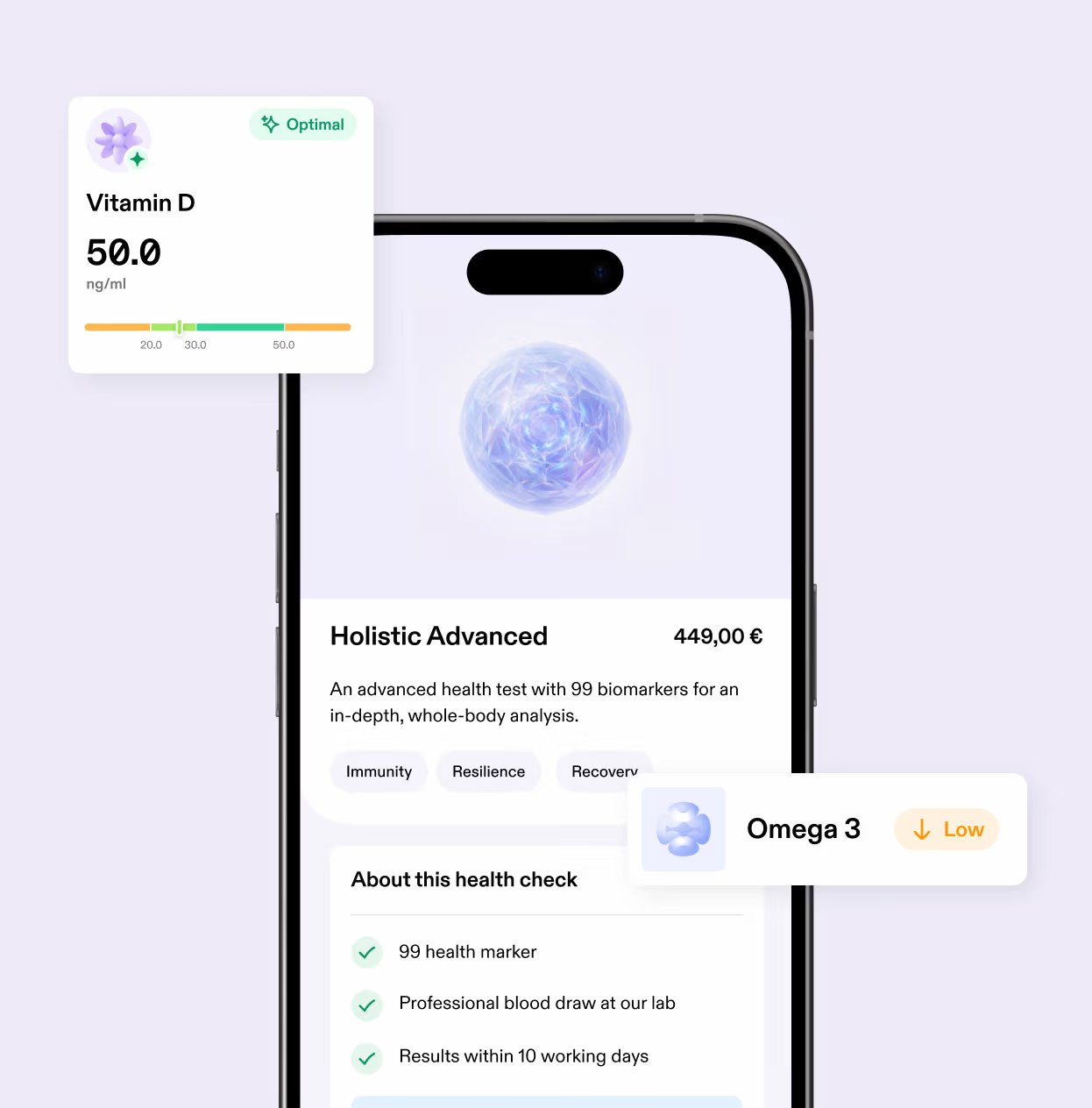
Holistic Advanced Package
Holistic Advanced measures 78 biomarkers to track metabolism, heart, organs & immunity.
This article is for informational purposes only and does not constitute medical advice. Please consult a qualified healthcare professional for personal medical guidance.
What blood tests are most important for women's health?
Ferritin, TSH (plus Free T3 and Free T4), vitamin D, and female hormones (estradiol, progesterone, FSH, LH, and prolactin) are the markers most relevant to the symptoms women commonly report, including fatigue, mood changes, cycle irregularities, and hair changes. A comprehensive baseline like the Aware Holistic Advanced Panel covers the key metabolic and micronutrient markers as a starting point.
What is the gender data gap in healthcare?
The gender data gap in healthcare refers to the historical underrepresentation of women in clinical research and biomedical studies. Because many reference ranges and diagnostic criteria were developed from predominantly male datasets, they may not reflect the full range of normal for female physiology, particularly in the context of hormonal variation.
Can my blood test results be normal but I still feel unwell?
Yes. Standard reference ranges represent the range in which the majority of a population falls, not necessarily the range at which every individual feels well. Ferritin is a clear example: levels that technically fall within the published range can still be associated with fatigue, hair thinning, and reduced cognitive function in some women. Tracking your own baseline over time is often more informative than a single comparison against a population average.
How often should women get their hormones tested?
This depends on your circumstances. If you are trying to understand your cycle, experiencing irregular periods, or approaching perimenopause, testing once or twice a year, timed carefully in relation to your cycle, can be useful. If you have a confirmed thyroid condition or hormonal imbalance, your healthcare provider will typically advise on a monitoring schedule.
What is non-anaemic iron deficiency?
Non-anaemic iron deficiency is a condition where iron stores (measured by ferritin) are low enough to cause symptoms, but not low enough to have produced anaemia as detected by a standard full blood count. It is well-documented in the research literature and more common than many people, and some clinicians, realise. Symptoms can include persistent fatigue, brain fog, hair thinning, and low exercise tolerance.
Subscribe to our newsletter!
Articles, tips, and offers. Straight to your inbox.


Ready to take charge of your health?
Check, track, and improve your health and well-being.




.avif)
