

You've probably seen the chart. Twenty-eight neat days split into four colour-coded phases, with a little pictogram telling you when to lift heavy, when to rest, when to socialise, and when to eat chocolate without guilt. Cycle syncing has moved from niche biohacker advice to something your yoga instructor mentions between poses, and it does get something right: your body is not the same on day 3 as it is on day 14.
Then you try to live by the chart. You push hard in your "follicular power week" and feel flat. You schedule your big presentation at "ovulation peak" and your energy has already dipped. You lean into the luteal-phase "rest and nest" script and feel oddly restless. What the chart promised and what your body delivered don't line up.
The reason isn't that cycle syncing is wrong. It's that the chart is built on population averages, and your hormones are not average. Two women on the same day of their cycle can have Estradiol levels that differ by a factor of ten, both technically "normal." Cycle syncing without your actual numbers is a map drawn for someone else.
In one careful study of 85 healthy women, Stanczyk et al., 2021 mapped the entire cycle and found that Estradiol at ovulation spanned roughly 222 to 1959 pmol/L across the group. That's almost a tenfold gap between women the same lab called "normal." Progesterone in the luteal phase showed a similar spread. The chart you follow collapses that reality into a single number.
What's really happening in each phase
Before talking about what to test and why, it helps to see the four phases as they actually work, not as a stock illustration. Each phase is named after what the ovary is doing, and the hormones drive everything from your heart rate to your appetite to how chatty you feel.
In the menstrual phase, both Estradiol and Progesterone are at their lowest. Many women describe feeling quieter, more introspective, maybe lower energy. Through the follicular phase, Estradiol climbs steadily as a follicle matures. Estradiol interacts directly with serotonergic, dopaminergic and glutamate systems in the brain, which is part of why verbal fluency, social drive and motivation tend to lift through this phase (Barth et al., 2015).
Ovulation is a short window. Luteinising hormone surges, Estradiol hits its peak, and a small rise in Testosterone often sits alongside. Desire, confidence and sociability tend to peak here too. Research tracking daily hormone levels against daily diary entries found Estradiol positively predicted within-cycle swings in sexual desire, while Progesterone pushed them back down (Roney & Simmons, 2013).
Then comes the luteal phase. The corpus luteum releases Progesterone, which acts on GABA receptors and has a calming, sometimes sedating effect. Energy often turns inward. The premenstrual days can feel heavier if the Progesterone-to-Estradiol balance shifts sharply at the end.
The gap generic cycle syncing can't close
Here's where the pretty chart runs out of road. The curves above describe the average woman. You are not her.
A study that sampled hormones daily across full cycles in healthy young women put it directly: serum levels of LH, FSH, Estradiol and Progesterone vary widely between cycles for the same woman, and between different women (Stricker et al., 2006). Two people following the same "luteal phase rest" advice can have Progesterone levels three times apart. One might genuinely need the quiet; the other might feel under-stimulated and flat.
None of this is an argument against population averages. Reference ranges, medians and means are how medicine identifies what's typical, flags what's outside the range that warrants a closer look, and gives doctors a starting point when interpreting any single result. They're indispensable. The point is simply that an average is a starting point, not a personal prescription. Good clinical care uses the population data to frame the question and your individual numbers to answer it.
Cycle syncing built on population averages treats you like a statistical midpoint you've never actually been.
Ready to take charge of your health?


This is why so many women bounce off cycle syncing after a few months. The advice is sound in shape, but the amplitude is wrong for them. Your Estradiol peak might be dramatic, or it might be modest. Your luteal Progesterone might be high enough to make you want to hibernate, or low enough that you barely notice a shift. Without knowing where your numbers sit, you're guessing which version of "normal" you are.
There's a second gap that's easy to miss: Estradiol and Testosterone don't walk alone in your bloodstream. They travel bound to a protein called sex hormone-binding globulin, or SHBG. SHBG decides how much of each hormone is actually free and biologically active. Two women can have the exact same total Testosterone value, and because one has half the SHBG of the other, she effectively has twice the free Testosterone reaching her tissues. You see this with the Free Testosterone Index, which is the ratio of Testosterone to SHBG. It's a detail generic cycle syncing simply can't touch.
The markers that make cycle syncing personal
If the goal is a version of cycle syncing that actually fits your body, you need the hormones that set the shape and amplitude of your cycle. The Female Hormones panel covers nine of them.
Timing is the test itself
The single most important detail about a hormone panel is when you give blood. Because these values move so much within one cycle, a sample taken on the wrong day tells you something you can't use. The Female Hormones panel is designed to be taken on days 2 to 5 of your cycle, counting day 1 as the first day of full flow.
That window is the baseline. It's when Estradiol and Progesterone are both at their floor, when FSH and LH are in their clearest resting state, and when the other markers aren't being pulled around by the follicular climb. Any number you get from that window becomes a reference point you can return to, compare across tests, and use to interpret what's happening later in the cycle.
If you test outside that window: you get a snapshot without a reference frame. An Estradiol value on day 11 could be climbing gently or about to peak, and without knowing where you started, the number is hard to interpret.
What athletic research actually shows about cycle syncing
It's worth being honest about the evidence. A systematic review and meta-analysis of menstrual cycle effects on exercise performance concluded that the data are mixed, with no consensus that performance meaningfully differs by cycle phase in the average woman (McNulty et al., 2020). Group averages show only a small reduction in the early follicular phase, and the variation between individuals is larger than the effect itself.
What that means in practice: generic "train hard here, rest there" rules are too blunt. For some women the phase effect is real and worth respecting; for others it's barely visible and a rigid schedule just creates friction. The only way to tell which one you are is to pair how you feel with what your actual hormone levels look like.
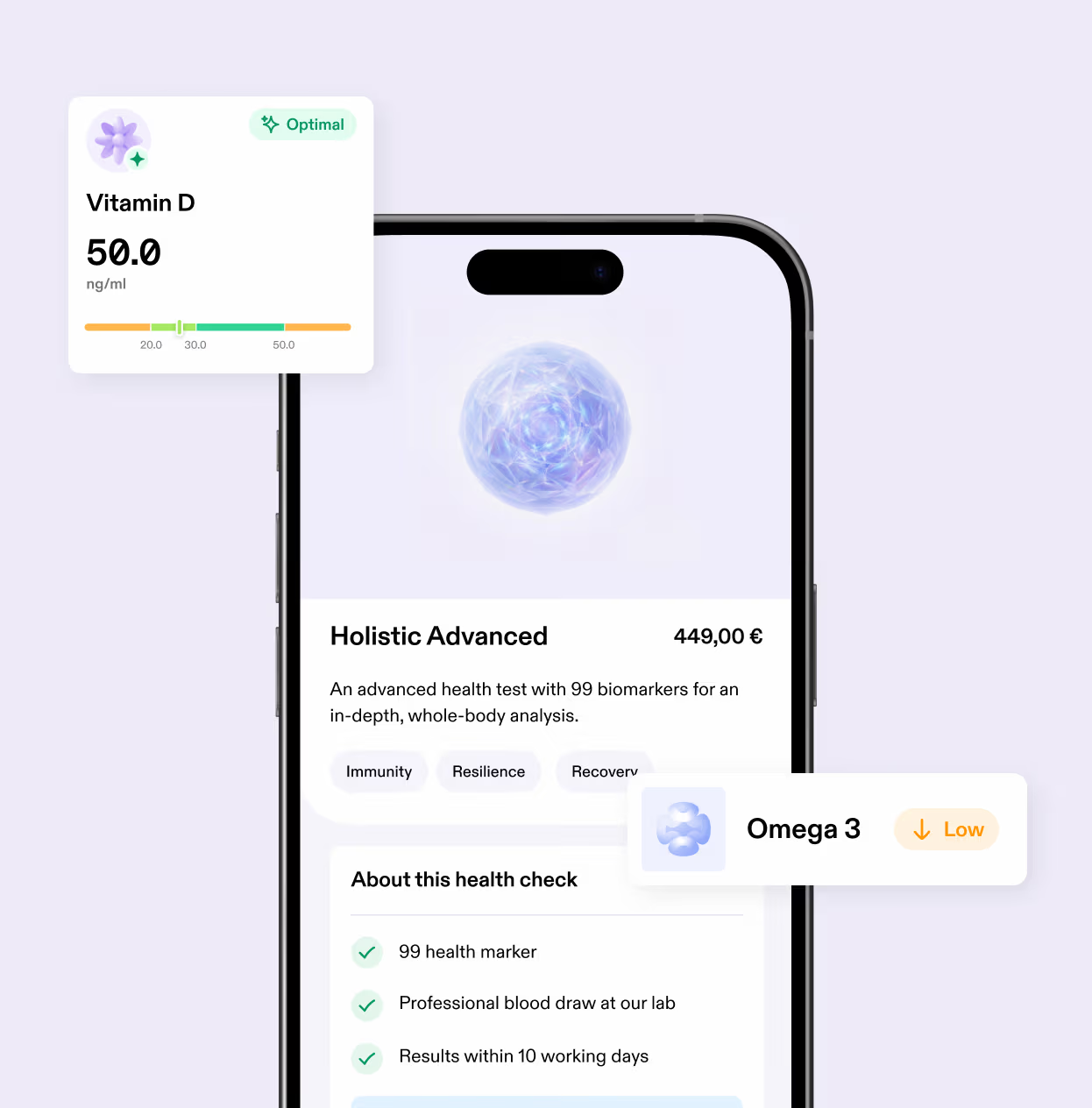
Holistic Advanced Package
Holistic Advanced measures 78 biomarkers to track metabolism, heart, organs & immunity.
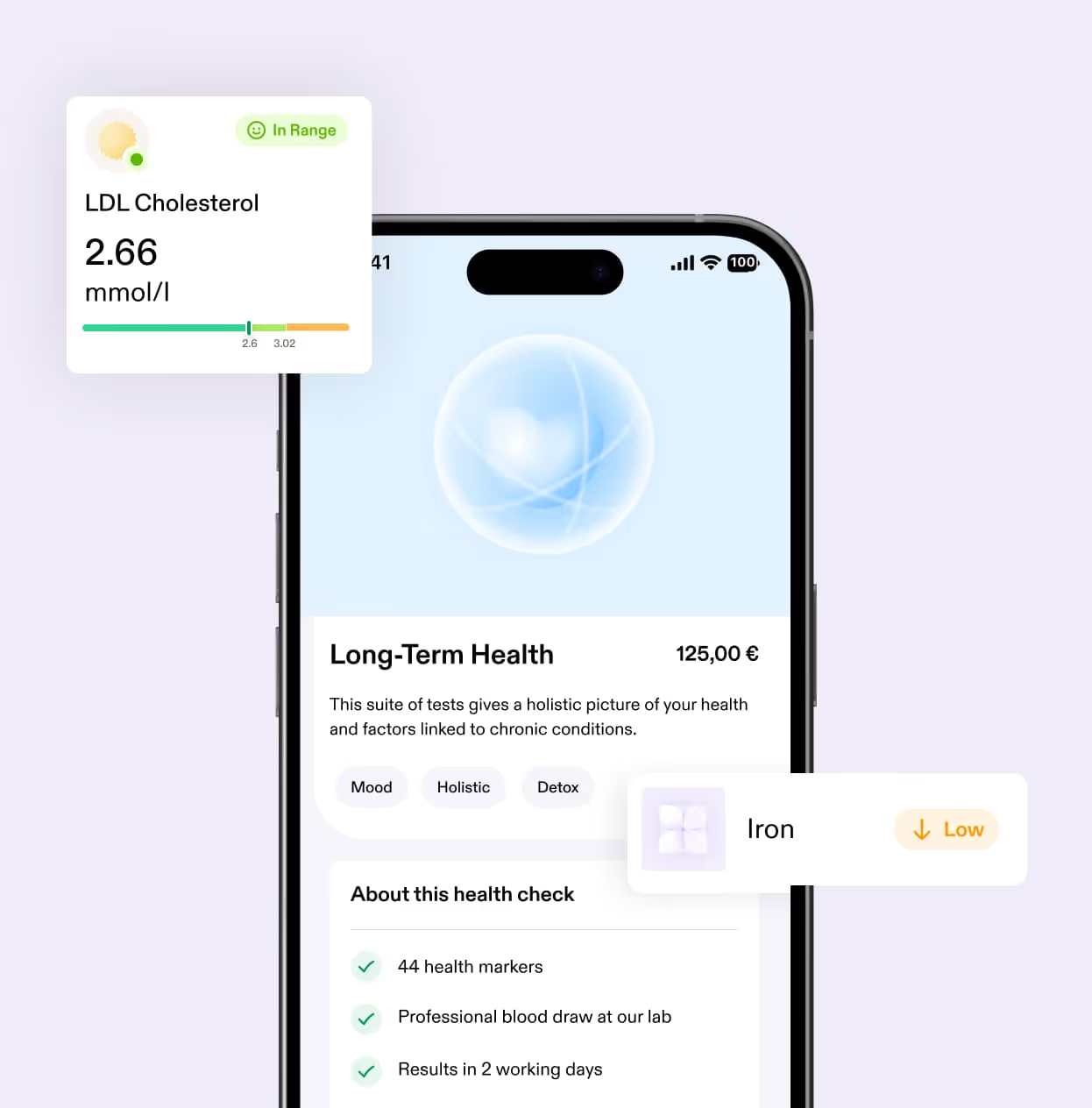
Long-Term Health Package
This suite of tests gives a holistic picture of your health and factors linked to chronic conditions.
Can I still do cycle syncing without testing?
Yes. Paying attention to your cycle at all is more than many women ever do, and the broad rhythms of energy, focus and mood are real. What a test adds is calibration: knowing whether your personal version of each phase is strong or muted, so you stop fighting advice that was never written for you.
Why do I need to test on days 2 to 5 specifically?
That's the baseline window, when your cycle's hormones are at their resting low. Values outside that window are moving targets and harder to interpret as a reference. Counting from day 1, which is the first day of full flow, gives you a consistent anchor you can use again in future tests.
What if my cycles are irregular?
It's still useful to test. Irregular cycles can reflect several things, including high Prolactin or a very different Estradiol to Progesterone balance. A baseline gives you and a healthcare professional something concrete to work from rather than guessing from symptoms alone.
Do I need to repeat this test every cycle?
No. A single baseline is a useful reference for months. Many women retest once or twice a year, or after something meaningful changes, like a new training programme, coming off hormonal contraception, or entering their late thirties when baselines can start to shift.
What's the difference between Testosterone and the Free Testosterone Index?
Total Testosterone tells you how much of the hormone is in your blood. The Free Testosterone Index uses SHBG to estimate how much of that Testosterone is actually unbound and available to your tissues. Two women with the same total can have very different free values, which is why the Index tends to line up better with how a woman actually feels.
Can hormonal contraception affect my results?
Yes, substantially. Hormonal contraception suppresses or replaces parts of your natural cycle, and SHBG in particular tends to rise on combined methods. Test results taken while on contraception reflect that context. Discuss your results with a healthcare professional who knows your method.
Subscribe to our newsletter!
Articles, tips, and offers. Straight to your inbox.


Ready to take charge of your health?
Check, track, and improve your health and well-being.




.avif)
