


You've probably heard of creatine in the context of the gym. More sets, faster recovery, fuller muscles. The sports science is solid. But over the last few years, researchers and longevity-focused practitioners have been asking a different question: what does creatine do for the brain? Given that your brain runs on the same energy currency as your muscles, the answer turns out to be surprisingly interesting.
The short version is that creatine is not a smart drug. It's a cellular energy buffer — and the brain, which accounts for roughly 20% of your body's total energy use despite being only 2% of its mass, relies on exactly the same phosphocreatine system that powers a sprint or a heavy set. When that buffer runs low — through a plant-heavy diet, poor sleep, sustained cognitive demand, or simply getting older — the effects show up in how you think.
Understanding who is most likely to benefit starts with knowing where your baseline sits. That's where blood testing becomes relevant.
What creatine actually does — and why the brain cares
Creatine is a naturally occurring compound produced in the liver and kidneys from glycine and arginine, and obtained from meat and fish in the diet. Its core function is energy transfer: it supports the phosphocreatine system, which allows cells to rapidly regenerate ATP — the molecule that powers almost every biological process — when demand spikes. ATP breaks down to ADP; creatine donates a phosphate group to convert it back. (Wallimann et al., 2011)
This mechanism is well established in muscle physiology. What has attracted more recent research attention is that neurons rely on exactly the same system. The brain is one of the most energy-intensive organs in the body, and cognitive tasks — sustained attention, working memory, complex decision-making — place real demand on the phosphocreatine buffer. When that buffer is well stocked, the brain has a reserve to draw on during high-demand periods. When it runs low, the effect can show up as mental fatigue, slower processing, and reduced working memory. (Mergenthaler et al., 2013)
"Creatine isn't making your brain work harder. It's helping ensure the fuel supply holds up — especially when you're under pressure."
Ready to take charge of your health?


The cognitive effect is not uniform. Most of the evidence for meaningful cognitive improvement comes from people who start with lower baseline creatine levels. Vegetarians and vegans consistently show lower brain creatine concentrations than omnivores because dietary creatine comes almost entirely from animal products. One double-blind controlled trial found that vegetarians who supplemented with creatine showed improvements in working memory and processing speed that were significantly more pronounced than in omnivores. (Rae et al., 2003) Sleep deprivation is another context where the buffer matters: early research suggests creatine may help offset the cognitive cost of acute sleep loss, particularly on tasks requiring sustained attention. (McMorris et al., 2007)
Age adds a third dimension. Brain creatine levels appear to decline with age, and the domains most affected — working memory, processing speed, executive function — are precisely those that longevity research monitors most closely. (Rawson & Venezia, 2011)
The biomarkers worth checking before you supplement
Creatine is one of the most studied supplements available and is well tolerated in healthy adults. But it affects several standard lab values in ways that can look alarming without context, and a pre-supplementation baseline makes follow-up testing much more interpretable. A few markers are also worth checking to understand whether creatine is the right starting point — or whether something else is driving cognitive fatigue first.

Sport Package
Check and optimize biomarkers linked to cardiovascular health and athletic performance.
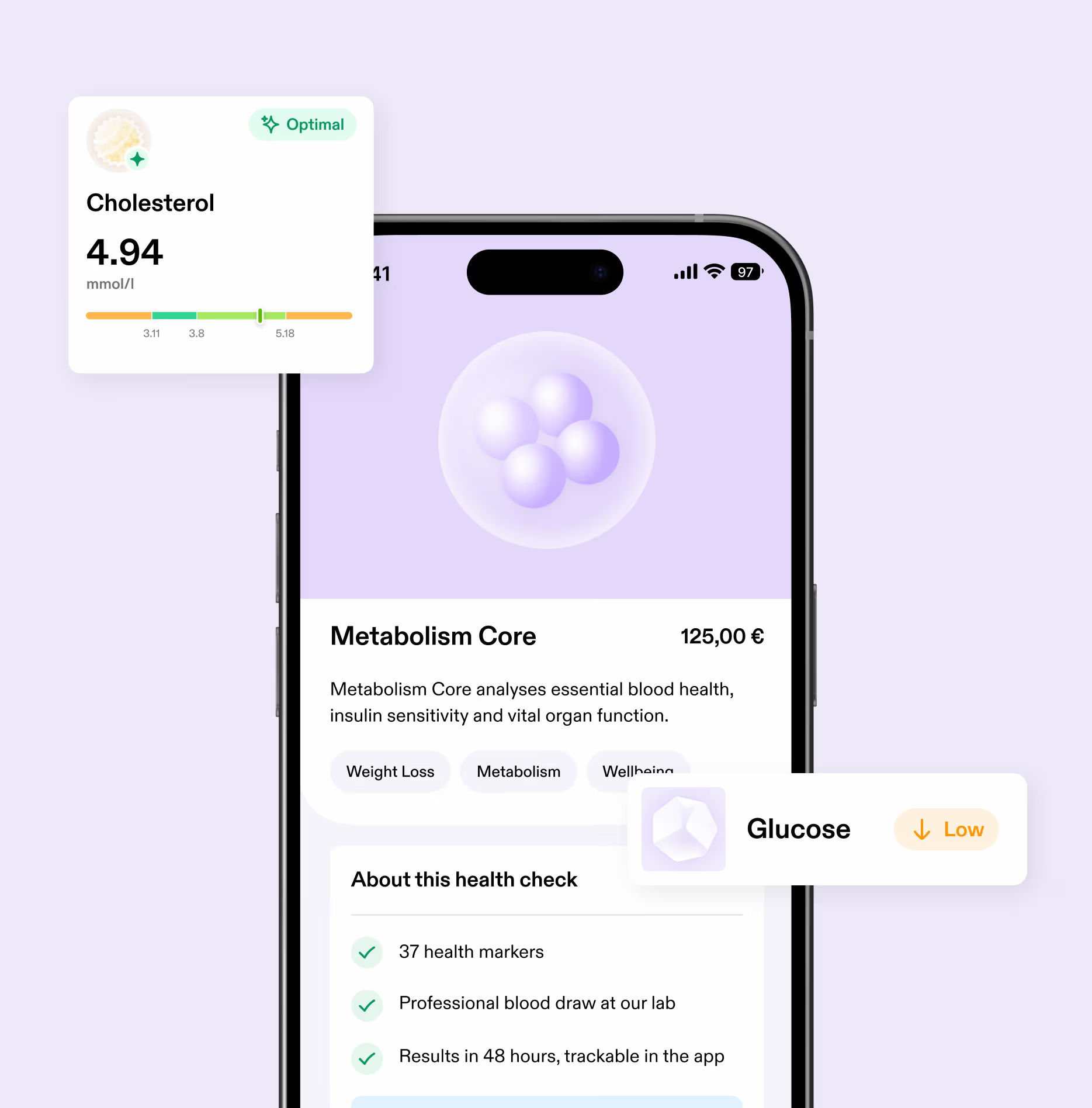
Metabolism Core Package
Metabolism Core analyses essential blood health, insulin sensitivity and vital organ function.
Who is most likely to benefit
The research is still developing, and most cognitive studies are small and short-term. But the mechanistic reasoning is sound, and certain groups have a clearer case than others.
Vegetarians and vegans have the strongest evidence base: lower baseline brain creatine means more room for the supplement to make a measurable difference, and studies consistently show more pronounced cognitive effects in this group than in omnivores. Older adults are a second well-supported group, with age-related decline in brain creatine overlapping neatly with age-related changes in working memory and processing speed. People who regularly face sustained cognitive demand — long working hours, complex decision-making, irregular sleep — represent a third plausible category, though the evidence here is earlier and less settled.
For most healthy omnivores with good sleep and adequate dietary protein, the cognitive effects of supplementation are likely to be modest. The value of a baseline test is partly to determine which group you actually fall into — something you cannot know from guesswork alone.
Practical guidance on dose and form
Creatine monohydrate is the form used in the vast majority of human studies, is highly bioavailable, and is considerably cheaper than alternatives like creatine HCl or buffered variants. There is no good evidence that other forms outperform it. A daily dose of 3–5g is sufficient to saturate both muscle and brain stores over several weeks without a loading phase. Consistency matters more than timing. Take it with water or food; the time of day makes little practical difference.
Brain stores take longer to saturate than muscle stores — around four to six weeks for a meaningful increase in cerebral creatine concentration. Any cognitive effects will be slow to appear. Give it a full cycle before drawing conclusions.
Stay well hydrated. Creatine draws water into muscle cells, and adequate fluid intake matters particularly in the first weeks. If you have pre-existing kidney disease or any concerns about kidney function, speak to a doctor before starting. For healthy adults, the long-term safety profile is well established. (Persky & Brazeau, 2001)
How to check your baseline with Aware
Aware's Sport package covers the markers most relevant for someone starting or already using creatine: vitamin B12, folate, ferritin and the full iron panel, hs-CRP, and the Omega-3 Index — alongside a full blood count. A single fasting draw. Results back within 10 working days and displayed in the Aware app with reference ranges, plain-language explanations, and trend tracking across test cycles.
What to do once you have your results
A single test result is a starting point. What matters is the direction it points — and whether a follow-up test after supplementation shows the shift you were expecting.
Verbessert Kreatin tatsächlich die kognitive Leistung?
Die Evidenz deutet darauf hin – vor allem bei Menschen mit niedrigeren Ausgangs-Kreatinspiegeln: Vegetarier:innen, Veganer:innen, ältere Erwachsene und alle, die unter Schlafmangel oder hoher kognitiver Belastung leiden. Die Effekte bei gesunden Omnivoren mit normalem Kreatin-Status sind geringer und weniger konsistent. Kreatin ist kein „Smart Drug". Es ist ein Molekül zur Unterstützung der zellulären Energie – und der Nutzen hängt stark vom Ausgangspunkt ab.
Is creatine safe for long-term use?
For healthy adults without pre-existing kidney conditions, creatine monohydrate has a strong long-term safety record. It's one of the most researched sports supplements available. That said, if you have any kidney or liver concerns, or take medications, it's worth discussing with your GP before starting. Regular blood tests help you keep track of creatinine and kidney function markers while supplementing.
Why does creatine raise creatinine on blood tests?
Creatinine is the waste product of creatine metabolism. It's generated as creatine is used and broken down by muscle. When you supplement creatine, your body has more creatine to metabolise, so creatinine levels rise. This is expected and doesn't indicate kidney damage in otherwise healthy people. Having a pre-supplementation baseline is useful so you can contextualise any changes you see on a follow-up test.
Sollten Vegetarier:innen und Veganer:innen Kreatin supplementieren?
<div class="faq-a">Es ist einen Blick wert. Kreatin aus der Nahrung stammt fast ausschließlich aus Fleisch und Fisch. Studien zeigen durchgängig, dass Vegetarier:innen und Veganer:innen niedrigere Kreatin-Spiegel in Gehirn und Muskeln haben – und die kognitive Reaktion auf Supplementierung fällt in dieser Gruppe offenbar stärker aus. Eine tägliche Dosis von 3–5 g Kreatin-Monohydrat ist sicher und gut erforscht. Vorher B12, Homocystein und Nierenfunktionswerte zu checken gibt dir ein klareres Bild.</div>
Which form of creatine is best?
Creatine monohydrate. The alternatives: hydrochloride, Kre-Alkalyn, buffered versions tend to cost more and have less evidence behind them. The monohydrate form is the one used in the vast majority of human studies, it's highly bioavailable, and the price difference is significant. Unless you have specific gastrointestinal issues with the standard form, there's no compelling reason to switch.
Subscribe to our newsletter!
Articles, tips, and offers. Straight to your inbox.


Ready to take charge of your health?
Check, track, and improve your health and well-being.




.avif)
